Posts

Contact Details

Please subscribe to get the  posts directly.   If you have any questions regarding any of posts p lease feel free to contact me at   Email:-  tutorassistance@gmail.com skype:-  englishtutor4u  facebook:- sa mons mathews (englishtutor4u)  
Image
The village of Kumarakom is a cluster of little islands on the Vembanad Lake in Kerala, a state in India. Geographically, it is located at 9.35 North and 76.26 East. Kumarakom's soil is extremely fertile due to the proximity of the water source, this has resulted in the growth of a wide variety of flora in Kumarakom, especially the mangrove and coconut trees. Vembanad Lake is home to several types of marine life exclusively the 'Karimeen' (Pearl Spotted Fish), the 'Chemeen' (Prawns) and the 'Konju' (Tiger Prawns). The Kerala Backwaters are a chain of brackish lagoons and lakes lying parallel to the Arabian Sea coast (known as the Malabar Coast) of Kerala state in southern India. Local people call it Kayals The backwaters of Kerala- twisty inland lakes networked by canals - extend to over 1900km..Vembanad lake is the largest of the lakes, covering an area of 200 sq km, and bordered by Alappuzha (Alleppey), Kottayam, and Ernakulam districts. Jus...

St. John's Cathedral Archdiocese of Thiruvalla (Kerala)

Image
A Cathedral in Thiruvalla, Kerala incorporating the features of a traditional Hindu Temple, a Mosque and Church This church was built in 1972 ,The church building is structured to suit the liturgical orientation of an individual church It is an exemplar for all churches in a diocese.This church has a unique architectural design, which was done by an ingenious architect, the well sort after, Mr. Larry Becker. The Arch Bishop of that time was attracted by this man's talent in architectural designs and approached him with the proposition to design the Cathedral, which was yet to materialize in the heart of the town.This cathedral is set up high on 12 pillars symbolizing after the 12 apostles of Christ. The pillars are positioned in a manner to shape the whole cathedral in to a wide circle. The stone walls reach a height of about 10 feet and the roof about 75 feet .The cross erected above the cathedral is about 25 feet in length.Th...

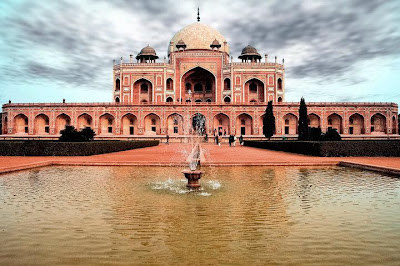
The Tomb of Emperor Humayun (1570 AD). Nizamuddin East, New Delhi

Image
  Built by Haji Begum, the widow of Mughal Emperor Humanyun in 1570. Humayun's Tomb in Delhi, the first garden-tomb in the Indian subcontinent, had teased the architectural novelty that Taj Mahal finally gave shape to. This tomb in New Delhi was built by Haji Begum, the Persian widow of Humanyun, at a cost of Rs 1.5 million through 8 years. A complex of buildings displaying Mughal architecture in Nizamuddin East, it consists of the main tomb of the Emperor Humayun as well as several others, including the Barber's Tomb. Mughal emperor Humayan, was not able to rule for a long time as he met with his untimely death after he falling from the stairs of the Sher Mandal library. Sayyed Muhammad ibn Mirak Ghiyathuddin and his father Mirak Ghiyathuddin brought in from ...

Kapaleswarar Kovil Gopuram, Chennai

Image
This is a Shiva temple, located in Mylapore, which is in the Indian state of Tamil Nadu. The form of Shiva's wife Parvati worshipped at this temple is called Karpagambal (from Tamil, "goddess of the wish-yielding tree"). The Pallava Nayanmars built this temple around the 7th century CE. According to the Puranas, Shakti worshipped Shiva, in the form of a peacock, which is why the vernacular name Mylai was given to the area that developed around the temple, as Mayil means Peacock in Tamil. You can find so many big and small temples of similar kin all over Tamil Nadu.

Buddhist Site at Sanchi, Madhya Pradesh

Image
The Sanchi stupa, built in and around 283 BCE by Ashoka, the famous Indian emperor who converted to Buddhism, is better known for its scriptures. The second largest stupa in India after that of Amravati, the Sanchi stupa is surrounded by a railing with four carved gateways facing towards all four directions. The entire stupa comprises symbolic representation of the gifts of nature as if explaining the Buddhist doctrine by reflecting the people's love for the nature. The use of lotus in stupa symbolises the rise of people from the mud of materialism to the reality and spirituality of life. Similarly, the female tree spirits depicted in the gateways are symbols of fertility.

Dakshineshwar Temple, Barrackpore, West Bengal (1850)

Image
In 1847, Rani Rashmoni of Bengal began the construction of the famous Dakshineswar Kali Temple. Rani, who was a rich and pious widow of colonial Bengal had a divine revelation ordering her to construct a temple dedicated to goddess Kali. She started building the magnificent temple after this revelation. In spite of immense wealth she did not come from a very high caste being a Shudra. The Shudras, being the meanial class were not qualified to offer cooked rice to the deity as an offering. But rani out of her intense devotion didn't want her much loved Kali to go half starved by eating only fruits and uncooked rice. She called upon the Brahmins of greater Bengal to come and adjudicate on this problem. No Brahmin was liberal enough to break the unequal social evils and strictly forbade rani to offer cooked food to the goddess. Rani grew morose. At this time a learned scholar, Ramkumar Chattopadhay, who was the elder brother of Ramakrishna Paramahamsa came forward ...